2026 has been a big year for psilocybin research in depression. Two of the most closely watched trials reported results — and they point in different directions. Here’s what each of these psilocybin depression trials found, in plain language.
Key takeaways
COMP006 (581 people) met its main goal: the 25 mg group’s depression scores improved more than the 1 mg comparison group’s at week 6.
EPISODE (144 people) missed its main goal, though some secondary measures favoured 25 mg.
Side effects on dosing days were common, and serious events were uncommon but did occur.
COMP006: a positive Phase 3 result
In February 2026, Compass Pathways reported results from COMP006, the second of two late-stage (Phase 3) trials of its psilocybin formulation, COMP360, in treatment-resistant depression — depression that hasn’t improved after multiple standard treatments.
581 people across North America and Europe received two doses three weeks apart: 25 mg, 10 mg, or 1 mg (the 1 mg group acts as a near-placebo comparison).
On the main measure — change in depression score (MADRS) at week 6 — the 25 mg group improved more than the 1 mg group, by an average of 3.8 points, a statistically significant difference.
Most side effects (headache, nausea, anxiety, visual changes) were mild to moderate and resolved within a day. Six people in the 25 mg group (2%) had a serious adverse event, and the independent safety board reported no new or unexpected concerns.
Compass has said it plans to file for U.S. FDA review. COMP360 already holds FDA “Breakthrough Therapy” status for this condition.
EPISODE: a missed primary goal, with interesting signals
In March 2026, JAMA Psychiatry published EPISODE, a German trial of 144 adults with treatment-resistant depression, all of whom also received psychotherapy.
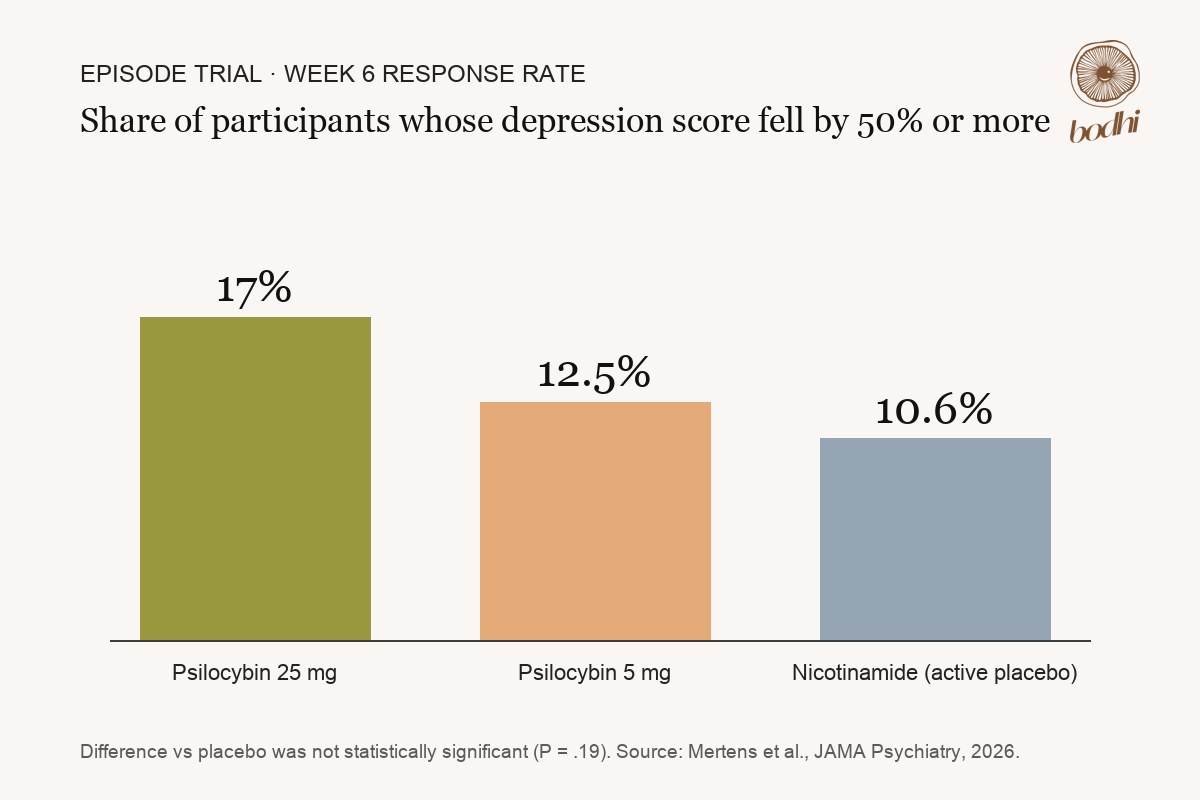
The trial’s primary goal was a 50% or greater drop in depression score at week 6. That goal wasn’t met: 17% of people on 25 mg psilocybin responded, compared with 12.5% on 5 mg and about 11% on the active placebo (nicotinamide).
Several secondary measures did favour the 25 mg dose — for example, a larger average drop in depression scores and a faster early response at week 1 — but because the main outcome missed, those are treated as exploratory.
Nearly everyone on 25 mg reported side effects, mostly temporary and on dosing days. There were four serious adverse events overall, two judged related to the 25 mg dose, including one case of lasting visual disturbance (HPPD).
The authors called their results inconclusive and recommended larger confirmatory trials.
EPISODE’s primary result: the 25 mg group’s response rate wasn’t significantly higher than placebo. Chart by Bodhi; data from Mertens et al., JAMA Psychiatry 2026.
Why do psilocybin depression trials disagree?
Mixed results are normal in medical research. Trials differ in size, the people they enrol, how “success” is defined and how well participants are blinded. Psychedelic trials face a particular challenge: most people can tell whether they received a full dose, which can influence how they report symptoms.
The takeaway
Psilocybin therapy for treatment-resistant depression is being studied seriously, with at least one large Phase 3 trial meeting its main goal.
Results are not uniform, side effects are common on dosing days, and serious events, while uncommon, do occur.
These treatments are delivered in controlled clinical settings with screening, preparation and professional support — very different from unsupervised use.
Did psilocybin work for depression in 2026’s trials? Results were mixed. The large COMP006 Phase 3 trial met its primary endpoint, while the German EPISODE trial did not, although some of its secondary measures were positive.
Is psilocybin therapy approved in Canada? No. Psilocybin remains a controlled substance. Access is limited to Health Canada special exemptions and approved clinical trials.
What side effects were reported? Mostly temporary effects on dosing days, such as headache, nausea, anxiety and visual changes. A small number of serious events occurred in both trials.
This article is for general education only and isn’t medical advice. Psilocybin is a controlled substance in Canada, legally accessible only through Health Canada exemptions or approved clinical trials. If you’re living with depression, please speak with a qualified health professional.
Mertens et al., “Efficacy and Safety of Psilocybin in Treatment-Resistant Major Depression: The EPISODE Randomized Clinical Trial,” JAMA Psychiatry (Mar 18, 2026): https://pmc.ncbi.nlm.nih.gov/articles/PMC13000742/